The Real Cost of Checking Every Site Every Minute
Jul 9, 2026 · 2 min read
Four options, not an infinite dial
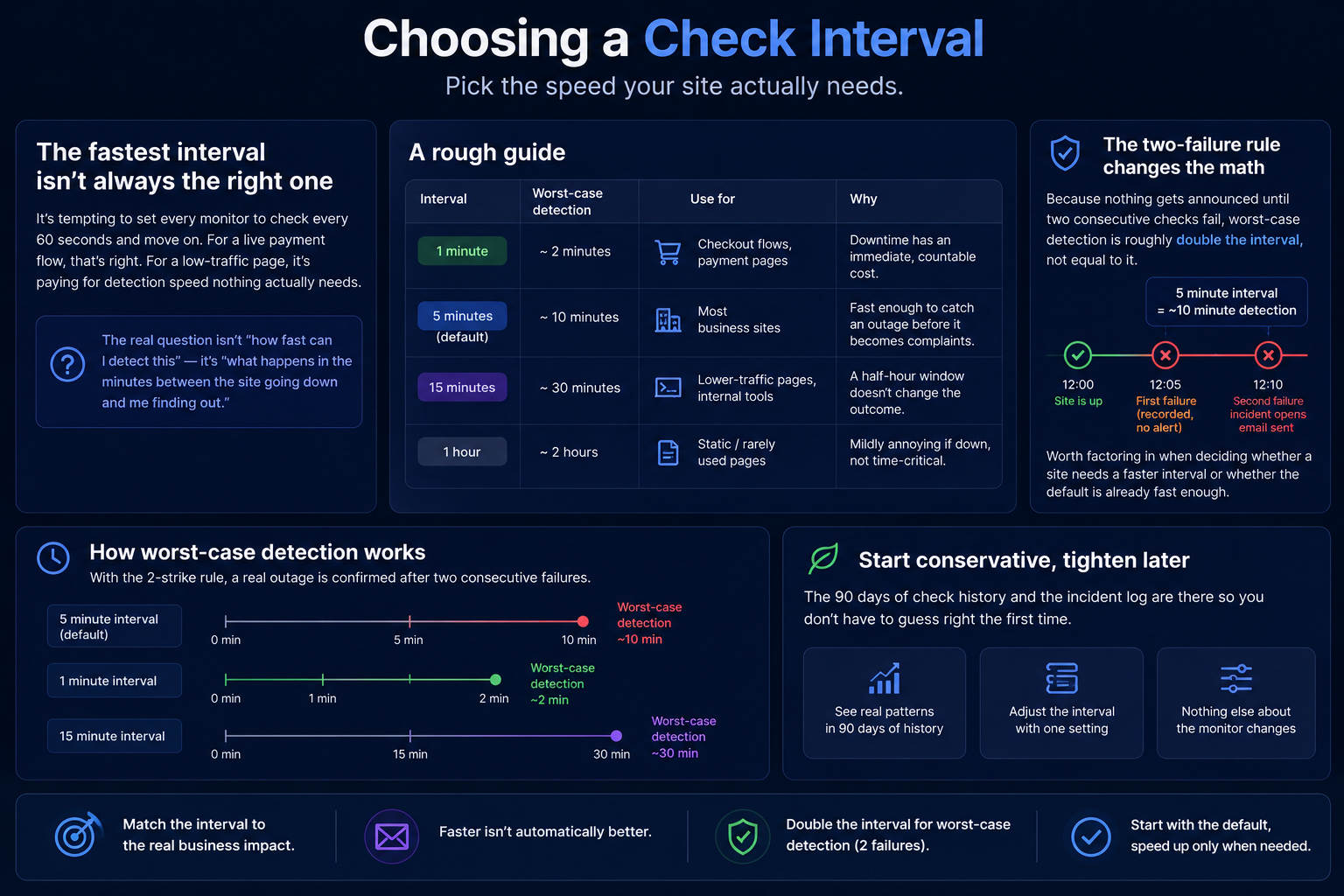
Every monitor can be set to check every 1, 5, 10, or 60 minutes. It's tempting to put everything on 1 minute and call it maximally safe — but the gap between those four numbers is worth understanding before defaulting to the fastest one everywhere.
What each interval actually buys
Because an incident only opens after two consecutive failures, worst-case detection is roughly double the interval, not equal to it:
- 1 minute → worst case ~2 minutes to detection. The right call for checkout flows and anything where every extra minute of downtime has a countable cost.
- 5 minutes → worst case ~10 minutes. The default for most business sites — fast enough to catch an outage before it becomes a pattern of support tickets.
- 10 minutes → worst case ~20 minutes. Reasonable for lower-traffic pages and internal tools where half an hour genuinely doesn't change the outcome.
- 60 minutes → worst case ~2 hours. A static page that would be mildly annoying, not urgent, to have down for a while.
Where the returns stop
Going from 60 minutes to 10 is a meaningful jump in how fast you find out. Going from 5 minutes to 1 is a much smaller jump in outcome for most sites — you're trading four extra checks an hour for roughly eight fewer minutes of not-yet-knowing, on a page where nobody's mid-checkout anyway.
The setting isn't permanent
Nothing else about how a monitor behaves changes when you change its interval — it's one setting, free to start conservative and tighten later if a site turns out to matter more than you first thought.