Choosing a Check Interval That Actually Matches What a Site Is Worth
Aug 18, 2026 · 2 min read
The fastest interval isn't always the right one
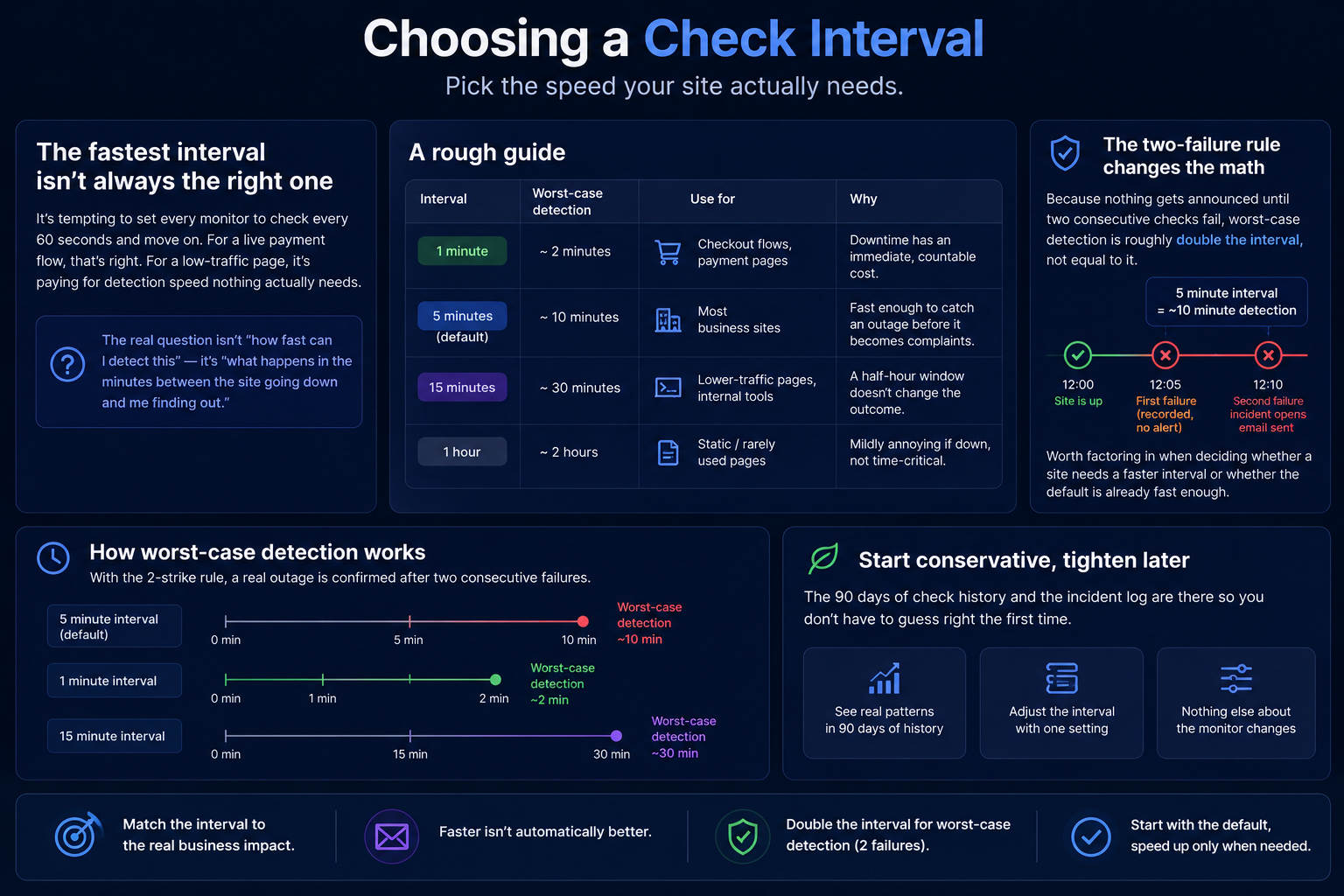
It's tempting to set every monitor to check every 60 seconds and move on. For a storefront taking live payments, that's the right call. For a marketing page that gets a trickle of traffic overnight, it's paying for detection speed nothing downstream actually needs.
The real question isn't "how fast can I detect this" — it's "what happens in the minutes between the site going down and me finding out."
A rough guide
Every 1 minute — checkout flows, payment pages, anything where downtime has an immediate, countable cost. Worst-case detection with the 2-strike rule is about two minutes.
Every 5 minutes (the default) — most business sites. A ten-minute worst case is fast enough to catch an outage before it becomes a pattern of complaints, without treating every site like it's processing live transactions.
Every 15 minutes — lower-traffic pages, internal tools, anything where a half-hour detection window genuinely doesn't change the outcome.
Every hour — a static page that would be mildly annoying to have down for a while, not something anyone is actively relying on right now.
The two-failure rule changes the math
Because nothing gets announced until two consecutive checks fail, worst-case detection is roughly double the interval, not equal to it. A five-minute interval means a real outage is confirmed in about ten minutes, not five — worth factoring in when deciding whether a site needs a faster interval or whether the default is already fast enough.
Start conservative, tighten later
The 90 days of check history and the incident log are there specifically so you don't have to guess right the first time. If a site turns out to need faster detection, the interval is one setting to change — nothing else about how the monitor behaves is different.